Floor Screeding & Self-Levelling for New Floors, SE London & Kent
Floor screeding, in the way we do it, means a thin self-levelling compound poured over a primed concrete base so the new LVT, vinyl or laminate has a flat, sound surface to sit on. We take moisture readings first and quote the work in writing after a free survey.
Uneven concrete, patch repairs and old adhesive
Most of the floors we level have been through several lives. A kitchen extension meets an older slab at a slight step, a radiator pipe has been chased in and filled by hand, or a previous vinyl has left ridges of black adhesive across the room. None of that matters much under a thick carpet. Under a thin glue-down plank it reads straight through the surface as dips, bumps and lines.
A levelling compound fills those low spots and gives the floor one flat plane. It is a preparation layer under floor coverings, not a structural screed. We do not lay sand and cement or anhydrite structural screeds; if a floor needs that, it is a job for a groundwork or screeding contractor before we arrive.
Assess, read moisture, prime, pour, check
The work follows the same steps set out on our subfloor preparation page. Old coverings are lifted and the base is assessed for level, damp and soundness. Moisture readings come next, because an impermeable floor over a wet base is a failure waiting to happen. Loose material and old adhesive are removed or treated, and the surface is primed so the compound bonds instead of drying out too fast.
The compound is then mixed and poured, flowing out under its own weight. Once it has cured to the manufacturer's specification, we recheck the levels with a long straightedge. When it passes, the subfloor is signed off ready for LVT, vinyl or laminate, normally the following day.
Compounds we use
Levelling products we regularly use include Mapei Ultraplan and Ultraplan Eco, Ardex Feather Finish and K15, and F. Ball Stopgap 1200 Pro. Feather finishes suit shallow smoothing, while the self-levelling compounds handle wider areas that need to flow flat. The choice depends on depth, base and the floor covering going on top, and the product is named on your quote.
Timber floors are a different case and normally take a plywood overlay rather than a pour. Our self-levelling screed guide explains the difference in plain terms.
Adhesive removal and levelling for businesses
Shops, offices and salons often come with years of old adhesive under worn carpet tiles or vinyl. Removing that residue, smoothing and levelling, and checking moisture on the concrete are all part of the preparation listed on our commercial flooring page. Where trading hours matter, the work can be planned for evenings or weekends.
What screeding costs
Subfloor preparation starts from £12/m², quoted after survey. The final figure depends on the depth of levelling, the state of the base and how much old adhesive has to come off. Our subfloor preparation cost guide walks through those drivers, and the full price list is on the pricing page.
Levelling is often the step that decides how good a new floor looks. It is why we recommend it ahead of LVT and herringbone flooring, where the pattern makes any unevenness easier to spot.
Screed preparation on site
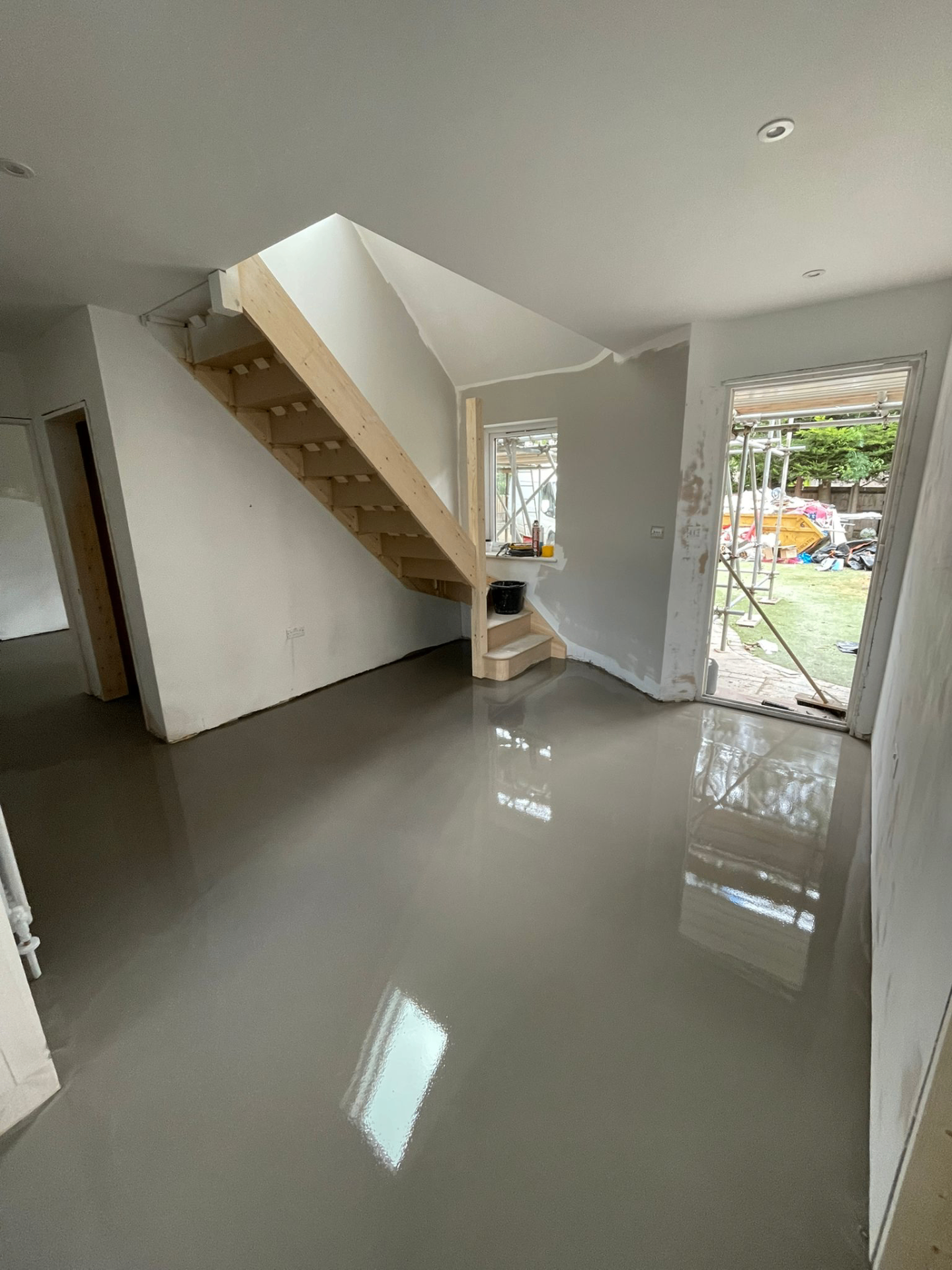
Floor levelling across Kent and South East London
Floor screeding questions
How long does self-levelling screed take to cure before flooring goes down?
A thin levelling pour cures in a few hours, which is why the new floor can often follow close behind. Deeper pours and damp-proof membranes take longer. We leave the compound to cure to the manufacturer's specification and recheck it before anything is laid.
Do I need screed under LVT?
Very often, yes. Glue-down LVT is only a few millimetres thick, so every bump and trowel ridge shows through. Latex levelling is rarely optional under LVT on concrete, and under-preparation is the single biggest reason those floors fail early.
Can you level over old quarry tiles or adhesive?
Old tiles can be levelled over only if they are firmly bonded. Any that sound hollow when tapped have come loose and must be lifted first. Old adhesive residue is removed or treated so the new compound has a sound surface to bond to.
Do you check for damp first?
Yes. Moisture readings are taken before any compound or impermeable floor covering goes down. A base that is still damp will cause problems later, so it is dealt with before levelling, not after.
Can screeding be done in a single room?
Yes. Preparation is priced per square metre and quoted after the survey, so a single kitchen, hallway or bathroom can be levelled on its own ahead of the new floor.